
Please ensure Javascript is enabled for purposes of website accessibility

On July 29, EmployIndy President + CEO Ken Clark testified before the U.S. Senate Committee on Health, Education, Labor and Pensions Subcommittee on Employment and Workplace Safety during a hearing examining the impact of artificial intelligence on the American workforce.

Representing EmployIndy and the workforce development perspective, Ken shared how AI is reshaping jobs, the opportunities it creates for workers and employers, and the policies needed to ensure more people can benefit from this transformation.

WRITTEN TESTIMONY

—AI is Not the Story Being Told

Chairman Banks, Ranking Member Hickenlooper, members of the Subcommittee – thank you for the opportunity to testify today.

My name is Ken Clark, and I serve as President & CEO of EmployIndy, the workforce board for Indianapolis and Marion County, Indiana. EmployIndy brings together employers, educators, community organizations, and government partners to strengthen our regional workforce. We help businesses build the talent they need while connecting jobseekers to education, training, and quality careers. Our work spans high school work-based learning, postsecondary success, adult workforce services, and employer engagement. Because we work across the full talent pipeline, we have a unique perspective on issues across workforce development.

Indianapolis serves as the economic engine of Central Indiana and is home to a diverse regional economy. Known as the “Crossroads of America,” Indianapolis is one of the nation’s premier transportation and logistics hubs, where interstate highways, rail networks, and one of the world’s busiest cargo airports converge to move goods across the country. Like many major metropolitan areas today, healthcare continues to be our largest employment sector. Advanced manufacturing is a cornerstone of our workforce with employers such as Allison Transmission and Rolls-Royce. We are a global leader in life sciences with major corporations like Eli Lilly and Roche Diagnostics headquartered in Indianapolis. Our hospitality and sports entertainment sector is second to none, bringing that Hoosier Hospitality to life as we seamlessly host large-scale events like the NCAA Final Four, U.S. Olympic Swimming Trials, and dozens of conventions like Gen-Con and Future Farmers of America, bringing hundreds of thousands of visitors to our city every year.

Each of these economic engines for Indianapolis are driven and supported by companies of all sizes. It is our job at EmployIndy to ensure there is a pipeline of talent connecting Indianapolis residents to economic mobility through the quality jobs they bring to Central Indiana.

—Perspective from a Career in Technology

Early in my career, I consulted on large technology projects. Before joining EmployIndy, I spent more than three years as City Controller and held multiple technology leadership roles, including as the City of Indianapolis’ Chief Information Officer, where I led major IT modernization initiatives and restructured the city’s technological cost and revenue models. I am proud to say my work contributed to the City of Indianapolis receiving the TechPoint Mira Award for Corporate Innovator of the Year, and I was individually recognized as an Indianapolis Business Journal Chief Technology Officer of the Year in 2018.

After joining EmployIndy, I served as Executive Vice President of Programmatic Operations, leading the design and delivery of our workforce development strategy, strengthening employer partnerships, expanding access to career pathways, and using labor market intelligence to drive decision-making. Today, I have the privilege of serving as President & CEO.

Those experiences, spanning both technology leadership and workforce development, have reinforced an important lesson: technology is most successful not when it replaces people, but when organizations thoughtfully adapt how people work. That is why I view artificial intelligence first and foremost as a workforce issue.

Throughout my career, I have witnessed successive waves of technological innovation arrive with promises of solving all our problems and fundamentally changing how people work. Cloud computing. Big data. The internet of things. In my experience, each wave ultimately changed work, but rarely in the sweeping ways early predictions suggested. Some advancements endured; others faded. More often than not, the boldest promises from Silicon Valley and technology leaders were not fully realized.

The impact of AI on the workforce will likely resemble how the internet and email became standard business tools a generation ago. They fundamentally changed how we worked, making information more accessible, communication nearly instantaneous, and organizations more productive. Some occupations, such as mailroom and courier roles declined, while entirely new careers emerged in IT departments, web development, and digital marketing.

AI is already impacting nearly every industry, and we need to prepare for that reality. However, there is a pervasive narrative that AI will usher in large-scale automation, widespread displacement, and mass unemployment. Based on both my technology background and my experience leading workforce development, I view the story differently.

—The Real AI Story

Artificial intelligence is not simply a technology story; it is a workforce story. AI will reshape far more jobs than it replaces. That is what our employer partners, labor market information, and our workforce system are showing us. National research increasingly points to the same conclusion.

According to Molly Kinder, a labor researcher formerly with Brookings and a leading voice on AI and the workforce, the most consequential phase of AI adoption may be the transition between today’s labor market and a more automated future.1 Kinder argues that the real challenge lies in the “messy middle,” when AI drives concentrated job losses in specific occupations, particularly among knowledge workers, even if overall employment remains relatively stable.

The question before us is not whether AI will eliminate jobs, but which jobs will require adaptation and how do we prepare our current and future workforce.

That distinction matters because AI’s impact will vary dramatically across occupations. There is no near future where your plumber is going to be anything but a human. There is still going to be an overwhelming need for workers in skilled trades. When we talk about the hospitality industry in Central Indiana, the Indianapolis Motor Speedway is still going to be filled with people working to make the Indy 500 a success.

The evidence increasingly suggests that AI’s greatest impact will be on tasks that make up jobs, reshaping occupations and disrupting traditional pathways into the workforce rather than simply replacing workers outright.2 3 Our responsibility is to ensure workers can adapt before disruption becomes displacement. For employers, that means preparing for a future where jobs are increasingly redesigned around AI, requiring new skills, new hiring strategies, and new approaches to developing talent, not simply fewer workers. It will require investment by the public and private sectors to ensure that workers have the resources and pathways they need to reskill and upskill into positions where AI is complementary, not threatening.

Recent analysis from Indiana’s Department of Workforce Development reaches a similar conclusion. They found early evidence that shows slow growth in knowledge worker openings but concluded it remains too early to draw conclusions. At the same time, the research recommends continued monitoring and investment in skills that are augmented, not replaced, by AI.
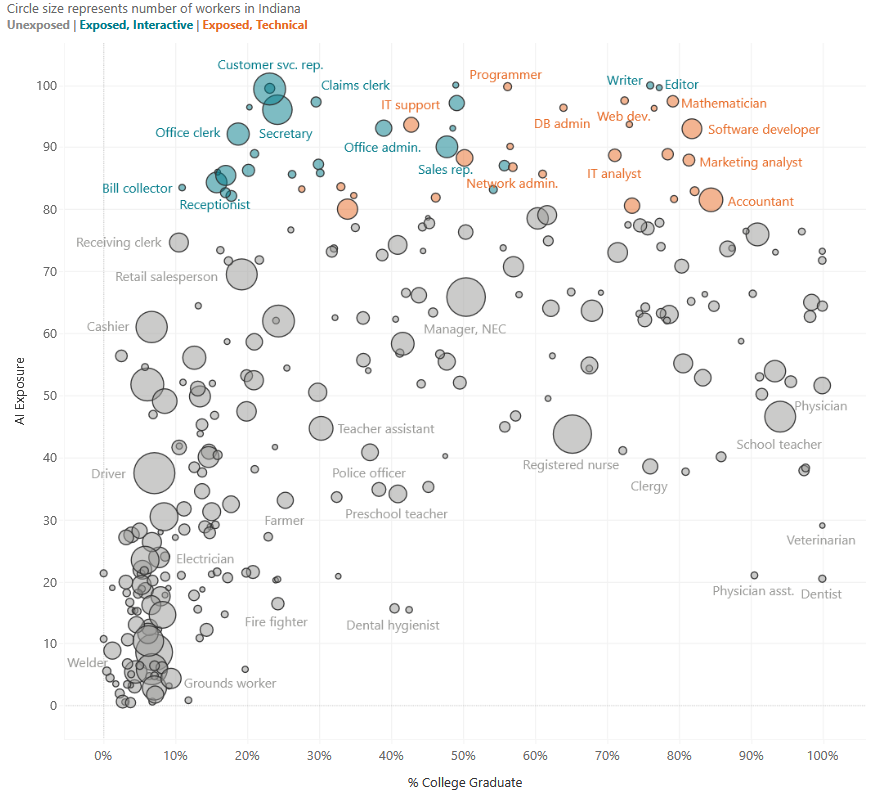
The above figure from the article “Is AI Affecting Indiana’s Labor Market?” illustrates why this distinction matters.Occupations with the highest levels of AI exposure are concentrated among administrative, technical, and professional roles. AI is changing how work is performed rather than eliminating the need for workers altogether. This shifts the conversation from predicting mass unemployment to preparing workers, employers, and workforce systems for change and innovation.

From where I sit as the leader of Indianapolis’ workforce development board, I believe there are three realities that have become increasingly clear about artificial intelligence and the workforce. AI is reshaping far more jobs than it is replacing. The greatest risk is not widespread unemployment, but the disruption of traditional pathways into careers. And local workforce systems will play a critical role in helping workers and employers adapt, but only if they have the information and resources to do so.

The evidence we are seeing on the ground points us in that direction. Let me share what our employers, job seekers, and the workforce system are telling us.

—AI Looks Different Across Industries

The internet has fundamentally changed how we work. Yet we do not think of there being an “Internet Industry.” Instead, the internet became a tool that transformed nearly every industry in different ways. I believe AI will follow a similar path and look very different across industries.

Most workers will not need to become AI experts. What we are seeing is not an increase in AI-specific careers, but an increase in AI literate skills needed in existing occupations. Across industries, AI is becoming another productivity tool, one that workers will increasingly need to understand and use responsibly.

One example can be found in healthcare, specifically in the massive new hospital being built just north of downtown Indianapolis. The new IU Health facility, spanning 1 million square feet dedicated to inpatient care, will have 864 inpatient rooms, 50 operating rooms, and 110 care spaces in the emergency department.5

In addition to adding much-needed capacity to serve our residents’ well-being, this state-of-the-art hospital will have integrated technology allowing medical staff to use AI to expedite administrative work.6 7 By automatically pulling information from patient records, while complying with HIPAA and all relevant privacy statutes, and generating draft summaries for review, these tools streamline paperwork while preserving clinical oversight. The result is that nurses and other care team members can redirect time away from computers and toward bedside care.

This is an example of AI augmenting, not replacing workers. These tools take much of the detailed administrative tasks off a nurse’s plate. This does not replace the nurse. It removes time-consuming administrative work so nurses can focus on uniquely human aspects of their profession, like caring for patients, exercising clinical judgement, and building trust.

Healthcare provides one example. The technology sector and the skills required of entry-level workers tell a different but equally important story.

—Employers Are Redefining Entry-Level Readiness

TechPoint, one of EmployIndy’s partners to expand Indiana’s technology talent pipeline and connect them to employers in the tech industry, conducted a survey of 221 members of the state’s tech industry in May. This survey found that 78 percent of respondents use AI daily, as opposed to Gallup’s February 2026 survey which found about 13 percent of U.S. employees overall use AI daily in their roles.8

This rapid adoption demonstrates that AI is already becoming part of daily work in Indiana’s technology sector. The challenge is not whether employers will use AI, it is determining what new skills workers will need to succeed alongside it.

As employers determine how AI fits into their organizations, we are seeing the expectations for entry-level workers, early in career, and new graduates evolve. Employers are not simply looking for technical knowledge; they are looking for candidates who arrive with practical experience, adaptability, and the ability to work alongside new technologies. Increasingly, we see employers expect young people to bring much more to the table.

Fortunately, Indiana has already begun preparing students for this reality. Our new graduation pathways, developed in close collaboration with industry leaders, required the graduating class of 2023 to be the first to demonstrate employability skills through project-based, service-based, or work-based learning.

Our new statewide diploma standards also give options to students to earn honors seals in three different pathways: enrollment, employment, or enlistment. Students earning an honors-plus seal on the enrollment track (meaning those planning to go straight to higher education) will have earned 75 work-based learning hours, while those earning an honors-plus seal in the employment track will have accrued 650 work-based learning hours, an industry-recognized credential, three courses in a CTE pathway, and additional skill development.

Because Indiana requires students to demonstrate employability through meaningful work-based learning before graduation, our students are leaving high school with more experience under their belt, giving them a leg up against potential AI displacement of entry-level jobs and better positioning them to adapt to an AI-enabled workplace.

—The Real Risk

The greatest long-term workforce risk is not simply the loss of individual entry-level jobs. It is the potential erosion of the talent pipeline that employers rely on to develop their future workforce. If we fail to preserve opportunities for people to gain that early experience, we do not just lose today’s entry-level jobs; we weaken tomorrow’s workforce.

Every experienced professional was once an entry-level employee. Entry-level roles are where workers learn technical skills, develop professional judgement, build relationships, and acquire the institutional knowledge that organizations depend upon. Today’s junior software developer will become tomorrow’s senior engineer. Today’s legal associate becomes tomorrow’s law partner. Today’s apprentice becomes tomorrow’s master tradesperson.

What happens to a business, or a career field, if junior roles disappear? If AI significantly reduces opportunities for workers to gain early career experiences, and this pattern goes unaddressed, how will employers develop the next generation of experienced professionals? We must intentionally preserve the pathways through which inexperienced workers become experienced professionals.

This challenge is particularly significant in Indiana, where employers are already preparing for the retirement of experienced workers. Even without AI, demographic trends are creating succession challenges across many industries. If opportunities for early-career workers shrink at the same time experienced workers retire, employers risk losing both institutional knowledge of today’s workforce and the next generation prepared to replace it.

To be clear, what we are seeing today is that entry-level work is evolving rather than disappearing. Entry-level experience begins earlier with career-connected learning, internships, youth apprenticeships, and high school career experiences. As AI changes how work is performed, skills matter alongside credentials, and workers need to demonstrate they can learn new technologies, use AI effectively, validate outputs, think critically, and solve problems. That makes early workplace and real-world experiences more valuable than ever, allowing people to develop technical and durable skills alongside experienced workers before entering the workforce full time.

The movement toward skills-based hiring and real-world experience began before AI entered the public conversation. AI simply accelerates its importance. As technology changes how work is performed, our responsibility is not to preserve every task. It is to preserve the pathways and preparation through which people gain the experience, judgment, and skills every profession depends upon.

—Preparing Workers

If AI changes how work is performed, then we must also change how we prepare workers for success.

The role of workforce boards is to work directly with employers to identify the skills that truly matter and invest in training that reflects those evolving needs. Increasingly, employers tell us that the most valuable skills are also the most human like critical thinking, communication, judgment, ethics, collaboration, and emotional intelligence. AI should augment those skills, not replace them. Employers that succeed will use AI to increase human value, not eliminate it.

Jobseekers will need to learn how to use AI responsibly, when and when not to rely on AI, and how to think critically about AI-generated information. The biggest challenge is teaching students and workers to question AI, validate AI, recognize when AI is wrong, and identify bias.

When we talk about AI literacy, we are not talking about teaching everyone to become an AI engineer. We are talking about teaching workers how to use AI responsibly, recognize its limitations, question its outputs, identify bias, and know when human judgment must prevail.

Before workers can become AI literate, they must first be digitally literate. That means understanding productivity software, interpreting data, practicing good cybersecurity, and confidently using today’s workplace technologies. We often assume everyone possesses these skills. The reality is that they do not. If we race toward AI literacy without first ensuring digital literacy, we risk leaving even more workers behind.

—Preparing Employers

To bridge the amassing AI skills and literacy need, employers themselves must become AI trainers. But before they can train their employees, many employers are still learning themselves. They are experimenting with AI tools, testing where they create value, and determining how they fit within their organizations.

Currently, small to medium-sized employers in our region are just trying to wrap their minds around AI and how it impacts their business. Research by the New York Federal Reserve shows that 15.9 percent of employed respondents said their employers currently offer AI training.9 What we do not have a lot of information about is what these companies want out of AI. That tells us this technology is still in an experimental phase for many employers. They are not only learning how to use AI, but they are also deciding where it belongs in their business.

Large employers are moving a lot more quickly. These organizations have the scale and resources to invest in AI adoption, build internal expertise, and create structured learning opportunities for their workforce. Organizations like IBM, Accenture, Meta, and Google have opportunities for younger workers and graduates to take advantage of free training, certificates, and even apprenticeship programs that cover a continuum of learning from fundamentals certifications to paid training for data analytics.

This disparity of preparedness between our small employers and our large corporations, if unchecked, could create an ever-widening gap of haves and have-nots, as corporations with the resources to integrate AI become more efficient while those without fall further behind. For a community like Indianapolis where small and medium sized businesses make up most of our employers, this disparity could be very detrimental to our economy.

This is another opportunity for local workforce boards to play an important role, not by telling employers how to use AI, but by helping them understand emerging workforce trends, identify evolving skill needs, connect to training resources, and share promising practices across industries.

—The Role of Local Workforce Boards

If AI’s impact differs across industries, occupations, and communities, then the response must also be local. That is why local workforce development boards matter, we play an indispensable role.

The Workforce Innovation and Opportunity Act reflects Congress’ intent to create a public workforce system built on advancement and partnerships between state and local leaders, tasks local workforce boards with implementing service delivery, understanding and acting on regional labor markets and needs, and building trust with local employers. Those responsibilities become even more important during periods of technological change because workforce boards sit at the intersection of employers, education, economic development, and workforce training.

Simply put, local workforce boards serve as translators across the workforce ecosystem. We translate employer demand into education and training strategies. We translate national labor market trends into local action. And we translate emerging technologies into practical workforce solutions for employers, educators, and job seekers.

At the same time, that means much of the responsibility for understanding AI’s impact on the local labor markets, and helping communities prepare for it, falls to local workforce boards as well.

Today, local workforce boards rely on a combination of traditional labor market information, WIOA performance data, and employer notifications through the WARN Act. Those tools help us understand where the labor market has been and when significant layoffs occur, but they were not designed to identify how AI is changing the tasks within occupations or signal emerging workforce disruption before workers are displaced.

That is why the AI Workforce PREPARE Act is so important. Rather than creating a new workforce program, the legislation strengthens our ability to understand how AI is reshaping work by improving federal labor market data, forecasting, and research. Those investments will help local workforce boards, employers, educators, and policymakers make real-time and data-informed decisions before workforce disruption occurs.

Local labor market intelligence matters more than national headlines because AI’s real impacts will be felt differently from one community to the next. National research from organizations like Brookings suggests that while AI is likely to reshape tasks across millions of jobs, its effects will vary considerably across regions because local industry mix, occupational composition, and career pathways differ.10 11 Those findings reinforce why local workforce boards need better and earlier labor market intelligence alongside stronger forecasting tools. These are the capabilities the AI Workforce PREPARE Act is designed to strengthen through improved federal data collection, AI workforce research, and more robust labor market information. Our role is to translate national trends into local action for employers, educators, and workers.

Local workforce boards do not simply respond to labor market changes; we help preserve and strengthen the talent pipelines and career pathways that allow workers to advance over time. As AI reshapes how people enter occupations, we work with employers, educators, and training providers to ensure those pathways evolve rather than disappear.

I am optimistic because this is not the first time American workers and industries have adapted to technological change. Throughout our history, workers and employers have embraced modern technologies, learned new skills, and created new opportunities. AI is moving us to do it once more. The challenge before us is not whether we can adapt, but whether we will have the information to adapt quickly enough.

That is why I support the AI Workforce PREPARE Act. The legislation recognizes that preparing for AI begins with better understanding its impact. By strengthening labor market data, improving occupational projections, expanding AI workforce research, and helping federal, state, and local partners make better use of that information, the bill gives workforce boards, employers, educators, and policymakers the tools they need to respond before disruption becomes displacement.

Local workforce development boards stand ready to do that work. Every day, we help employers identify changing skill needs, prepare workers for new opportunities, and build the talent pipelines our regional economies depend on. Give us timely information, stronger forecasting tools, and the partnerships envisioned in the PREPARE Act, and I am confident workforce boards across this country will help ensure AI strengthens, not weakens, the American workforce.

EmployIndy is proud to announce the addition of four new community-based organizations to the YES Indy network, strengthening our ability to connect more young adults across Marion County to career training, education, and employment opportunities. 

The newest YES Indy service providers are: 

  • Brightwood Community Center 
  • Community Action of Greater Indianapolis (CAGI) 
  • Community Research and Resource Center (CRRC) 
  • Nehemiah Project CDC 

These organizations join a growing network of community partners dedicated to helping young people overcome barriers, build skills, and access meaningful career pathways. YES Indy, one of EmployIndy’s youth workforce development initiatives, connects young adults ages 18 to 24 with opportunities that align with high-demand industries while providing the support needed to achieve long-term success. 

Through YES Indy, participants gain access to adult basic education, job readiness training, and supportive services tailored to their individual needs. While each career pathway offers a unique experience, every participant receives comprehensive guidance designed to prepare them for educational advancement, credential attainment, and sustainable employment. 

“Community-based organizations are at the heart of our work with young people,” said Dionne Smith, vice president of community career services at EmployIndy. “They build trust, understand the unique needs of the neighborhoods they serve, and provide the wraparound support that helps participants stay engaged and reach their goals. By expanding our network of partners, we’re able to connect more young adults to opportunities that can transform their futures.” 

A key component of YES Indy is its earn-and-learn model, which allows participants to gain hands-on work experience, develop career-ready skills, and earn income at the same time. This approach is especially impactful for young adults facing barriers to employment or education, providing immediate support while creating pathways to long-term economic mobility. 

Community partnerships play a critical role in delivering these outcomes. Organizations like Brightwood Community Center, CAGI, CRRC, and Nehemiah Project CDC help EmployIndy meet young people where they are, offering accessible services, and individualized support that encourage persistence and success. 

“Community Research and Resource Center is excited to partner with EmployIndy as this support strengthens our ability to connect young people,” said Belinda Drake, executive director at Community Research and Resource Center. “While our focus is on serving TLGBQ+ communities, we welcome and support all young people who are seeking pathways to employment, education, and long-term success. Through our VISION: Workforce Development & Economic Mobility program, we are continuing to advance our mission by meeting young people where they are, helping them identify their goals, and walking alongside them as they build a stronger future.” 

The impact of YES Indy continues to grow. In 2025, 681 young people participated in YES Indy services. More than half transitioned into education, credential training, or career pathways, generating an estimated $17.1 million in community impact. 

To learn more about YES Indy and the communities our community-based organizations serve, visit yesindy317.org. 

I’m pleased to share that Nate Klinck has been appointed as EmployIndy’s executive vice president of programs. Many of you have worked alongside Nate in his prior roles with our organization, including leading our policy and innovation team and serving in several interim executive capacities. Over the past few years, he has played a critical role in strengthening alignment across departments, advancing our systems change work, and helping drive our mission of empowering and innovating our local workforce ecosystem to promote equity and remove barriers to quality employment.

Nate brings more than two decades of experience across workforce development, talent systems, and economic development. His background in state policy, nonprofit leadership, and largescale workforce strategy uniquely positions him to guide the integration of EmployIndy’s programmatic areas — ensuring residents and employers continue to benefit from a coordinated, data informed workforce ecosystem.

As executive vice president of programs, Nate will oversee our core operational areas, including:

  • Community Career Services (WorkOne Indy, YES Indy)
  • Business Partnerships & Talent Connections
  • Career Connected Learning (Apprenticeships, Project Indy, Indy Achieves)

His leadership will help ensure that our services remain responsive to emerging labor market needs and grounded in equity, collaboration, and measurable impact.

Ken ClarkThank you for your continued partnership and for all you do to strengthen and innovate Indy’s workforce.

Ken L. Clark
President + CEO

We want to hear from you!
EmployIndy is working with Transform Consulting Group to develop a strategic plan to strengthen our region’s workforce. We are seeking input from community members to better understand the key needs and opportunities for Central Indiana’s workforce to inform this plan.

The survey should take no more than five minutes to complete.

Your feedback will help to build a more skilled, equitable, and responsive workforce across Central Indiana.

After completing this survey, you will be entered into a drawing to win a $100 gift card!

To be included in the drawing, please include your email address in the comments at the end of the survey. Up to ten individuals who submit the survey will receive a $100 gift card. 

If you have any questions, contact Megan Hershey, Project Consultant at Transform Consulting Group, at [email protected].

a message from our president & CEO—

As 2025 comes to a close, I am spending the holidays doing what I love most: time with my five brothers, four sisters, their spouses, and my 25 nieces and nephews. Being together, sharing meals, stories, and a bit of chaos, always reminds me what matters most in life.

Growing up, my parents and teachers identified early that service was in my heart. At the time, I didn’t fully understand what that would look like. What I know now is that service is less about a title or a role and more about showing up—listening carefully, acting with integrity, and committing to something bigger than yourself.

That belief is what led me to EmployIndy. It is what excites me most as we step into a new year together.

In my first months in this role, my priority is learning. I am visiting and listening to our community partners, employers, educators, and staff to better understand what’s working, where trust needs to be strengthened, and how EmployIndy can continue to be a reliable and responsive partner in Indianapolis’s workforce ecosystem. Alongside that learning, EmployIndy will be advancing our strategic planning work, clarifying our priorities, and aligning our resources to support equitable access to opportunity across our city.

A new year always carries a sense of hope and possibility. For me, this moment represents new beginnings rooted in trust. Trust that is built through transparency, collaboration, and a shared commitment to serving our community well.

I’m grateful for the work that has come before me and optimistic about what we can build together in the year ahead. Thank you for being part of this journey, and I look forward to connecting with many of you in the months to come.

Ken ClarkKen L. Clark
President + CEO

I’m honored to step into the role of EmployIndy’s president and CEO. I am incredibly grateful to have worked and learned alongside the EmployIndy team and community partners these past years.  

EmployIndy has the privilege of supporting people in nearly every stage of their career, from young students exploring career paths all the way to late-in-career adults providing for their families, building stability and opportunity for our next generation. Our work is at the center of our community. The hope that comes with a new career opportunity—and the pride that comes with the ability to support yourself and your family—is a powerful mission we get to serve. EmployIndy is a connector and catalyst for the talent in Indianapolis, and I am thrilled to bring my perspective, passion, and experience as your partner in this work.

I am also incredibly grateful to Marie Mackintosh for her leadership, mentorship, and nearly decade-long commitment to EmployIndy. Her vision and steady hand have shaped a strong, values-driven organization, and I look forward to building upon the foundation she has helped create.  

As I move into this role, my top priority is to continue strengthening the partnerships and relationships that make our work possible—across employers, community organizations, education partners, and residents throughout Marion County. Together, we will continue connecting people to purpose and removing the barriers to equitable prosperity in our community. 

Thank you for your continued trust and support of EmployIndy. I’m excited for the work ahead and inspired by the impact we can create together. 

Wishing you and your loved ones a warm and joyful holiday season. 

Ken Clark
President + CEO, EmployIndy

Image courtesy of Visit Indy.

INDIANAPOLIS – 26 July 2023 – EmployIndy, Marion County’s Workforce Development Board, is thrilled to announce that Ken Clark has accepted the position of executive vice president, finance and operations where he will lead all aspects of the organization’s financial, administrative, operational and human resources strategy, systems and protocols. In this role, his leadership will drive the organization towards operational excellence in service of EmployIndy’s strategic goals and efforts to serve underrepresented residents with transformational workforce development services that advance economic mobility. 

“With Ken’s track record of optimizing financial performance, building high-performing teams and driving operational efficiencies, we’re excited to have him join the team and contribute to our important mission and vision,” said Marie Mackintosh, president and CEO of EmployIndy. Ken comes to EmployIndy from the City of Indianapolis & Marion County, where he spent over 3 years as the city controller and director of the office of finance and management. Ken has tremendous experience leading IT operations and finance in his previous roles, most notably chief information officer and chief financial officer at the Information Services Agency (ISA), including running IT strategy and operations that support the city’s departments as well as leading the restructure of the IT expense and revenue models. Ken’s work at the ISA earned the city and himself the Mira Award for Corporate Innovator of the Year and the IBJ’s CTO of the Year award in 2018. 

“I am excited to continue supporting the City of Indianapolis in this new role with EmployIndy. Witnessing EmployIndy grow their services and support our community through the economic turmoil of the pandemic and subsequent recovery has inspired me,” said Clark. “I look forward to furthering their vision of preparing Marion County residents for the workforce to secure livable wages and grow in careers while meeting employer demand for talent.” 

Clark joins the organization shortly after the announcement of its 2023-2025 Strategic Plan, grounded in four primary interventions: Career-Connected Learning, Coaching and Training, Talent Connection, and Job Quality. This plan will serve as the guiding commitment to Marion County while EmployIndy continues to be responsive to the evolving education, training, and career needs of the ecosystem as its workforce leader and intermediary.


INDIANAPOLIS – EmployIndy, Marion County’s Workforce Development Board and local workforce intermediary, is excited to announce its acceptance into the U.S. Department of Labor’s first ever cohort of the Job Quality Academy. The Job Quality Academy, designed and operated in partnership with Jobs For the Future (JFF), will provide EmployIndy the opportunity to build a greater understanding of job quality principles, how to incorporate them into their policies and programs, and develop methods and tools for assessing progress.

Good jobs are the foundation of an equitable economy that lifts workers and families and makes businesses more competitive, but many Americans lack work that provides them with decent pay, benefits, safety, or hours that allow them to take care of both their work and home responsibilities. These problems are even more pronounced for workers from historically marginalized communities and in certain industries, such as hospitality and the care economy.

The U.S. Departments of Labor and Commerce identified principles of a good job, which include equitable recruitment and hiring; benefits; diversity, equity, inclusion, and accessibility (DEIA); empowerment and representation; job security and working conditions; organizational culture; pay; and skills and career advancement. A good job is one that helps workers achieve economic stability and mobility, while prioritizing diversity and worker voice.

“We know the Job Quality Academy will add even more momentum to our efforts around good jobs, that we’ve outlined in our recently launched three-year strategic plan as well as the implementation of our Choice Employers initiative,” said Marie Mackintosh, president and CEO of EmployIndy. “Marion County businesses will be competitive and thrive when they invest in job quality and wage equity practices, leading to an increase in the number of good jobs in our regional economy and more prosperous workers.”

As expectations on employers to offer quality jobs in Central Indiana are rising, EmployIndy has recently launched its Choice Employers initiative to help Marion County organizations find the right combination of actions to reduce turnover, offer a strong company culture, and be considered an ideal place to work. Through the Good Wages Initiative, a pillar of Choice Employers, EmployIndy has already certified over 70 local employers, representing 18 industries and nearly 25,000 workers, who have committed to increasing worker wages by $5.1M.

With the additional three pillars of the Choice Employer initiative including Culture and Diversity, Employee Supports, and Career Pathways, EmployIndy will utilize the learnings and best practices from the Job Quality Academy to strengthen and increase its impact locally.

Launched in Spring 2023 and set to span roughly 6 months, including two 3-day in-person summits in Washington, DC, the Job Quality Academy comprises up to 16 teams, including workforce boards, state workforce boards, state workforce agencies, and tribal organizations, representing communities across the nation. To maximize learning, EmployIndy has invited representatives from three local employer partners, B&W Plumbing and Heating, IEC-Indy, and UA Local 440, to join them for the duration of the academy. With construction industry roles in high-demand, EmployIndy’s Job Quality Academy team chose these partners in order to produce a template that is replicable throughout all industries.

To learn more about the Job Quality Academy, visit www.jff.org/job-quality-academy. To learn more about becoming a Choice Employer in Marion County, visit www.employindy.org/choice-employers or contact Lora Steele at [email protected].

Marion County youths now have a choice when it comes to skills training. EmployIndy is launching a YouthBuild AmeriCorps Construction and Advance Manufacturing industries training and job placement opportunity for young adults ages 18 – 24.

YouthBuild Indy, in partnership with YouthBuild USA, AmeriCorps, Marian University, Martindale Brightwood Community Development Corporation, Training for Success LLC, and Turner Built  Indianapolis, will be offering this 18-week training for those Marion County residents ages 18-24 who are looking to get construction training or earn their HSE/GED while being paid.

The Construction industry in Marion County is projected to continue growing over the next five years, adding nearly 700 positions to the already great need due to the replacement and retirement of existing workers.

Participants can earn up to $6,780 as well as their high school diploma or equivalency. Students will also earn an NCCER construction certification and may qualify for a $1,300 AmeriCorps education award, work experience and job placement.

The Construction training program will take place from March 20th through July 21st, 2023. Classes meet every Monday through Friday from 9 AM to 2 PM. An information session will be held on March 1st at 37 Place Community Center, located at 2605 E 25th Street Indianapolis, IN 46218.

FLYER | REGISTER

Additionally, EmloyIndy’s YES Indy in partnership with Public Advocate in Community re-Entry (PACE), Training For Success, Marian University, Conexus Catapult and Ivy Tech Community College is sponsoring a 13-week Advanced Manufacturing training course, beginning on March 6th. Participants can earn up to $5,930 and a Catapult Advanced Manufacturing Standardized Work Training Certificate; they will also gain 6 Ivy Tech Community College credit hours, work experience and job placement.

The training requires a High School Diploma, GED, or High School Equivalency. Participants must be 18 – 24 years old, have six months or more of stable work history, access to transportation and want to pursue a manufacturing career. Advanced Manufacturing training starts with an orientation on March 1st and training will be held March 6th through June 2nd, classes meet every Monday through Friday at various times and locations. Limited spots are available for this training.

FLYER | REGISTER

The registration deadline for both training courses is February 24th. Reentry and justice-involved are welcome to apply.

INDIANAPOLIS — Today, February 6, 2023, EmployIndy, Marion County’s Workforce Development Board, has named Esther Woodson as its new executive director of Indy Achieves. Effective immediately, Woodson succeeds Matt Impink who has led the initiative since its launch by Mayor Joe Hogsett and his administration in 2018. Woodson joined EmployIndy in February 2019, most recently serving as senior director for Indy Achieves.  

Indy Achieves is focused on closing the skills gap in Indianapolis by increasing the proportion of residents with high-quality credentials to 65% by 2027 and by eliminating the attainment gaps that currently exist for minority students. To accomplish this, Indy Achieves works to actively increase the number of individuals who apply for existing financial aid programs such as 21st Century Scholars and FAFSA, as well as provide Promise Scholarships, Completion Grants and wraparound support services for Marion County students who attend Ivy Tech Indianapolis and IUPUI. 

Woodson, a native of Indianapolis, is a proud graduate of Indianapolis Public Schools and a 21st Century Scholar, attending Crispus Attucks Middle School and Northwest High School. She then went on to pursue her undergraduate degree at the Indiana University School of Journalism, followed by 15 years in secondary and post-secondary education in Indianapolis and will complete her pursuit of a graduate degree in Management and Leadership later this year. Today she attributes her personal and professional achievements to the 21st Century Scholars Program, along with a host of family, mentors, teachers and friends.  

“Indy Achieves Scholars are the future workforce and leaders of Marion County,” said Woodson. “I am excited to lead Indy Achieves forward, working collaboratively with K12 and postsecondary to ensure all Indianapolis students, particularly minorities, have the education, experiences and resources needed to complete a high-quality credential that leads to good and promising jobs in our community.” 

To improve access to postsecondary education, Indy Achieves processed 710 21st Century Scholars applications, accounting for roughly 19 percent of the overall scholars from Marion County in the 2021-2022 school year. To ensure postsecondary persistence and completion, Indy Achieves offers coaching services and scholarships that supported 199 graduates at IUPUI and Ivy Tech Indianapolis last year. This student success coaching model has increased postsecondary retention by as much as a13 percent over comparison groups.  

“This year, as Esther takes the reigns, Indy Achieves will grow by half a million dollars in City funding,” said Mayor Joe Hogsett. “That will enable our growing program to impact hundreds of additional Indianapolis students, many of them traveling a path that Esther knows personally.” 

Woodson has been recognized locally by several organizations for her commitment to education and community, receiving the Big Brothers Big Sisters of Central Indiana Big Sister of the Year Award in 2015 and the Live United Volunteer of the Year Award in 2014. She was recently a finalist for both the Center for Leadership Development Minority Achievers Award in 2022 and the Inspire Awards “The Power of Mentoring” Youth Mentor in 2018. A member of The Father’s Heart Ministries Church, Alpha Kappa Alpha Sorority, Inc. Chi Chi Omega Chapter, and an active Big Sister with Big Brothers Big Sisters of Central Indiana, Woodson resides on the west side of Indianapolis with her husband and two teenage sons.  

 ### 

A photo of Woodson can be sourced here. 

About EmployIndy 

EmployIndy guides the local workforce ecosystem and makes strategic investments to remove barriers to quality employment for underserved and underrepresented residents. Our vision is for all Marion County residents to have access to services and training necessary to secure a livable wage and grow in a career that meets employer demand for talent. As the workforce development board for Marion County, guided by 24 business, civic, education and nonprofit community leaders, EmployIndy invests over $20 million in public, private and philanthropic funds for both youth and adults annually. EmployIndy stands against all forms of racism – systemic, individual, and structural – as an anti-racist organization. Learn more at employindy.org. 

The worker voice is becoming more and more dominate in the decision-making process for businesses. The rise of Covid created a shift in how workers view jobs and which aspects of those jobs they find important. This is especially true for workers at the entry-level or “front line.”

Ritse Erumi and Martin Whittaker, in their recent Fortune article Americans know what they want from companies. It’s time to listen, summarize this shift in saying that “what the pandemic catalyzed was a fundamental shift in expectations for workers. With wage hikes over the past year failing to keep pace with record-high inflation, many workers are also feeling more dissatisfied.”

It’s for reasons such as these that EmployIndy is creating a Marion County Employer Resource Network (ERN), in partnership with ERN-USA. This national model was created first in Michigan and has been around for more than a decade, now spanning more than 10 states and with over 20 networks. It is a member-based program that serves the employees of the members who participate. Members are the companies themselves, and the cost of membership gives each employer access to a Success Coach. This Success Coach, which will be employed by EmployIndy’s ERN, is the designated “barrier navigator” helping individual employees navigate the external issues that impact their ability to come to work and/or do their work at their full potential.
In Indiana, Johnson County is the only other community that has an active program, and their employer members are seeing a lot of impact as the program moves into its second full year. Amanda Parkhurst with Endress+Hauser shared her motivations to join the program as a founding member: “As an HR professional, it’s difficult to be all things to all people, and we saw the ERN as an extension of our benefits offered to employees. The ERN allows for focused time to be spent on and with employees with an emphasis on finding resources for their specific needs.”

So, what happens after membership? And what is the real impact? Melissa Dewey from GMI, a local manufacturer, shared one such story. One employee at GMI had been struggling to get to work on time, to the point where it was affecting the person’s performance. Dewey knew the person was a good employee. The employee met with Johnson County’s ERN Success Coach, and the details of the tardiness came out. The staff member had a parent who did not have a drivers license. The parent needed to be taken to work regularly and this was causing the tardiness. The Success Coach was able to dig deeper and learn that the parent also didn’t speak English as a first language, which was contributing to the challenge of earning a driver’s license. But with some intervention and resource referring, the parent was able to pass a drivers test and was then able to drive to work every day. The GWI staff member was retained, and with the original need met, tardiness was no longer a problem.

This is just one example. When we factor in the cost of turnover, one employee saved is literally worth thousands of dollars for a business. ERN-USA puts the current return on investment of their services at more than 700% (from the organization’s latest annual report). And in addition to retention, ERNs can have positive impacts on employer recruitment, with many employers packaging the ERN membership as an addition to their employee benefits.

If you’re a Marion County business that’s struggling with worker retention, let’s talk about how to lighten your own load by investing in future satisfied employees. To learn more, reach out to EmployIndy’s business partnerships at [email protected] and they can help get your organization on the right path to better employee retention.

INDIANAPOLIS — Today, October 11, 2022, EmployIndy, Marion County’s Workforce Development Board, has named Marie Mackintosh as its new president and CEO. Effective immediately, Mackintosh succeeds Angela Carr Klitzsch who has led the organization under Mayor Joe Hogsett and his administration since June 2016. Mackintosh joined EmployIndy alongside Carr Klitzsch in June 2016 when she was appointed as the chief operating officer, most recently serving as the organization’s chief strategy officer.

“An Indianapolis native, Marie is keenly aware of the challenges residents face accessing good jobs in a post-pandemic economy with disproportionate opportunity,” said Mayor Hogsett. “She brings deep and valued relationships with key community stakeholders, officials, employers and funders who will pursue thoughtful and equitable workforce solutions for our community.”

Most recently, Mackintosh has led implementation of pivotal investments to improve the local workforce ecosystem, including talent development strategies aimed at addressing systemic barriers for employers and job seekers, including the New Skills Ready NetworkModern ApprenticeshipTalent Bound and Rapid Re-Employment Response. These integrated investments are aimed at ensuring students and job seekers have equitable postsecondary options – informed through career-connected learning – that offer economic mobility through good jobs and good wages, providing a diverse and well-prepared talent pool for Indianapolis employers to grow and thrive.

“I am incredibly proud of innovative solutions that EmployIndy and its partners have created for employers and workers alike during my first six years at EmployIndy,” said Mackintosh, “but our most important work continues to be ensuring a diverse and skilled workforce has equitable access to economic mobility through good jobs.”

In Marion County, the median income of white households is almost twice that of Black households, affirming that all opportunities are not created equal and that a concerted effort must continue to ensure we are building up our communities, households, and residents of color. From July 2021 to June 2022, EmployIndy assisted 50,000 Indianapolis residents, and of those who self-identified, 75% were people of color.

“New EmployIndy initiatives like Choice Employers and Good Wages are helping employers implement hiring and employment practices that will close this opportunity gap as job access, performance, satisfaction, and retention improve,” said Jay Styles, senior director, business partnerships. “Job quality boosts talent attraction in a big way and has currency when filling skilled positions.”

The Good Wages Initiative certifies, celebrates, and showcases Marion County employers that have voluntarily committed to providing full-time employees with a living wage – $18 per hour – and health insurance benefits, and is a recommended hiring and promotions strategy of Business Equity for Indy. Launched just this year, 58 local employers, representing 18 industries and over 23,400 workers are already committed to increasing worker wages by $4.2 million annually.

“As a Good Wages employer with a commitment to equity, EmployIndy sets the highest equity standards for itself as an employer in our community,” said Aman Brar, EmployIndy board chair. “In her new position, Marie will continue to drive thoughtful and equitable solutions through data- and partner-informed processes that further our goal of increasing access.”

Mackintosh brings over 20 years of relevant experience to this role, having worked immediately prior to EmployIndy in various leadership roles at the Indiana Department of Workforce Development, in marketing at a global manufacturer, and in advising and program development at Butler and Depauw universities, respectively. She holds an MBA from Butler University and a BA from Indiana University, she was named one of Indy’s Best and Brightest in 2017 and has served on committees and boards convened by the U.S. Conference of Mayors, Indy Chamber, Ascend Indiana, Business Equity for Indy, Far Eastside Collective Impact Council, Thomas Gregg Neighborhood School, and IndyFringe.