
On July 29, EmployIndy President + CEO Ken Clark testified before the U.S. Senate Committee on Health, Education, Labor and Pensions Subcommittee on Employment and Workplace Safety during a hearing examining the impact of artificial intelligence on the American workforce.
Representing EmployIndy and the workforce development perspective, Ken shared how AI is reshaping jobs, the opportunities it creates for workers and employers, and the policies needed to ensure more people can benefit from this transformation.
WRITTEN TESTIMONY
—AI is Not the Story Being Told
Chairman Banks, Ranking Member Hickenlooper, members of the Subcommittee – thank you for the opportunity to testify today.
My name is Ken Clark, and I serve as President & CEO of EmployIndy, the workforce board for Indianapolis and Marion County, Indiana. EmployIndy brings together employers, educators, community organizations, and government partners to strengthen our regional workforce. We help businesses build the talent they need while connecting jobseekers to education, training, and quality careers. Our work spans high school work-based learning, postsecondary success, adult workforce services, and employer engagement. Because we work across the full talent pipeline, we have a unique perspective on issues across workforce development.
Indianapolis serves as the economic engine of Central Indiana and is home to a diverse regional economy. Known as the “Crossroads of America,” Indianapolis is one of the nation’s premier transportation and logistics hubs, where interstate highways, rail networks, and one of the world’s busiest cargo airports converge to move goods across the country. Like many major metropolitan areas today, healthcare continues to be our largest employment sector. Advanced manufacturing is a cornerstone of our workforce with employers such as Allison Transmission and Rolls-Royce. We are a global leader in life sciences with major corporations like Eli Lilly and Roche Diagnostics headquartered in Indianapolis. Our hospitality and sports entertainment sector is second to none, bringing that Hoosier Hospitality to life as we seamlessly host large-scale events like the NCAA Final Four, U.S. Olympic Swimming Trials, and dozens of conventions like Gen-Con and Future Farmers of America, bringing hundreds of thousands of visitors to our city every year.
Each of these economic engines for Indianapolis are driven and supported by companies of all sizes. It is our job at EmployIndy to ensure there is a pipeline of talent connecting Indianapolis residents to economic mobility through the quality jobs they bring to Central Indiana.
—Perspective from a Career in Technology
Early in my career, I consulted on large technology projects. Before joining EmployIndy, I spent more than three years as City Controller and held multiple technology leadership roles, including as the City of Indianapolis’ Chief Information Officer, where I led major IT modernization initiatives and restructured the city’s technological cost and revenue models. I am proud to say my work contributed to the City of Indianapolis receiving the TechPoint Mira Award for Corporate Innovator of the Year, and I was individually recognized as an Indianapolis Business Journal Chief Technology Officer of the Year in 2018.
After joining EmployIndy, I served as Executive Vice President of Programmatic Operations, leading the design and delivery of our workforce development strategy, strengthening employer partnerships, expanding access to career pathways, and using labor market intelligence to drive decision-making. Today, I have the privilege of serving as President & CEO.
Those experiences, spanning both technology leadership and workforce development, have reinforced an important lesson: technology is most successful not when it replaces people, but when organizations thoughtfully adapt how people work. That is why I view artificial intelligence first and foremost as a workforce issue.
Throughout my career, I have witnessed successive waves of technological innovation arrive with promises of solving all our problems and fundamentally changing how people work. Cloud computing. Big data. The internet of things. In my experience, each wave ultimately changed work, but rarely in the sweeping ways early predictions suggested. Some advancements endured; others faded. More often than not, the boldest promises from Silicon Valley and technology leaders were not fully realized.
The impact of AI on the workforce will likely resemble how the internet and email became standard business tools a generation ago. They fundamentally changed how we worked, making information more accessible, communication nearly instantaneous, and organizations more productive. Some occupations, such as mailroom and courier roles declined, while entirely new careers emerged in IT departments, web development, and digital marketing.
AI is already impacting nearly every industry, and we need to prepare for that reality. However, there is a pervasive narrative that AI will usher in large-scale automation, widespread displacement, and mass unemployment. Based on both my technology background and my experience leading workforce development, I view the story differently.
—The Real AI Story
Artificial intelligence is not simply a technology story; it is a workforce story. AI will reshape far more jobs than it replaces. That is what our employer partners, labor market information, and our workforce system are showing us. National research increasingly points to the same conclusion.
According to Molly Kinder, a labor researcher formerly with Brookings and a leading voice on AI and the workforce, the most consequential phase of AI adoption may be the transition between today’s labor market and a more automated future.1 Kinder argues that the real challenge lies in the “messy middle,” when AI drives concentrated job losses in specific occupations, particularly among knowledge workers, even if overall employment remains relatively stable.
The question before us is not whether AI will eliminate jobs, but which jobs will require adaptation and how do we prepare our current and future workforce.
That distinction matters because AI’s impact will vary dramatically across occupations. There is no near future where your plumber is going to be anything but a human. There is still going to be an overwhelming need for workers in skilled trades. When we talk about the hospitality industry in Central Indiana, the Indianapolis Motor Speedway is still going to be filled with people working to make the Indy 500 a success.
The evidence increasingly suggests that AI’s greatest impact will be on tasks that make up jobs, reshaping occupations and disrupting traditional pathways into the workforce rather than simply replacing workers outright.2 3 Our responsibility is to ensure workers can adapt before disruption becomes displacement. For employers, that means preparing for a future where jobs are increasingly redesigned around AI, requiring new skills, new hiring strategies, and new approaches to developing talent, not simply fewer workers. It will require investment by the public and private sectors to ensure that workers have the resources and pathways they need to reskill and upskill into positions where AI is complementary, not threatening.
Recent analysis from Indiana’s Department of Workforce Development reaches a similar conclusion. They found early evidence that shows slow growth in knowledge worker openings but concluded it remains too early to draw conclusions. At the same time, the research recommends continued monitoring and investment in skills that are augmented, not replaced, by AI.
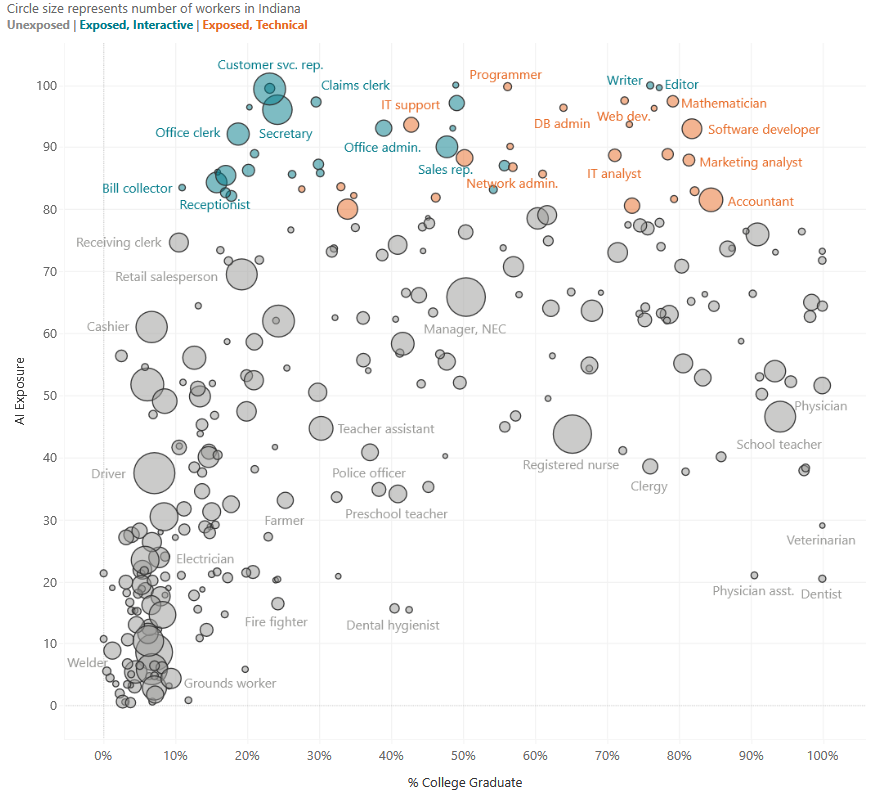
The above figure from the article “Is AI Affecting Indiana’s Labor Market?” illustrates why this distinction matters.Occupations with the highest levels of AI exposure are concentrated among administrative, technical, and professional roles. AI is changing how work is performed rather than eliminating the need for workers altogether. This shifts the conversation from predicting mass unemployment to preparing workers, employers, and workforce systems for change and innovation.
From where I sit as the leader of Indianapolis’ workforce development board, I believe there are three realities that have become increasingly clear about artificial intelligence and the workforce. AI is reshaping far more jobs than it is replacing. The greatest risk is not widespread unemployment, but the disruption of traditional pathways into careers. And local workforce systems will play a critical role in helping workers and employers adapt, but only if they have the information and resources to do so.
The evidence we are seeing on the ground points us in that direction. Let me share what our employers, job seekers, and the workforce system are telling us.
—AI Looks Different Across Industries
The internet has fundamentally changed how we work. Yet we do not think of there being an “Internet Industry.” Instead, the internet became a tool that transformed nearly every industry in different ways. I believe AI will follow a similar path and look very different across industries.
Most workers will not need to become AI experts. What we are seeing is not an increase in AI-specific careers, but an increase in AI literate skills needed in existing occupations. Across industries, AI is becoming another productivity tool, one that workers will increasingly need to understand and use responsibly.
One example can be found in healthcare, specifically in the massive new hospital being built just north of downtown Indianapolis. The new IU Health facility, spanning 1 million square feet dedicated to inpatient care, will have 864 inpatient rooms, 50 operating rooms, and 110 care spaces in the emergency department.5
In addition to adding much-needed capacity to serve our residents’ well-being, this state-of-the-art hospital will have integrated technology allowing medical staff to use AI to expedite administrative work.6 7 By automatically pulling information from patient records, while complying with HIPAA and all relevant privacy statutes, and generating draft summaries for review, these tools streamline paperwork while preserving clinical oversight. The result is that nurses and other care team members can redirect time away from computers and toward bedside care.
This is an example of AI augmenting, not replacing workers. These tools take much of the detailed administrative tasks off a nurse’s plate. This does not replace the nurse. It removes time-consuming administrative work so nurses can focus on uniquely human aspects of their profession, like caring for patients, exercising clinical judgement, and building trust.
Healthcare provides one example. The technology sector and the skills required of entry-level workers tell a different but equally important story.
—Employers Are Redefining Entry-Level Readiness
TechPoint, one of EmployIndy’s partners to expand Indiana’s technology talent pipeline and connect them to employers in the tech industry, conducted a survey of 221 members of the state’s tech industry in May. This survey found that 78 percent of respondents use AI daily, as opposed to Gallup’s February 2026 survey which found about 13 percent of U.S. employees overall use AI daily in their roles.8
This rapid adoption demonstrates that AI is already becoming part of daily work in Indiana’s technology sector. The challenge is not whether employers will use AI, it is determining what new skills workers will need to succeed alongside it.
As employers determine how AI fits into their organizations, we are seeing the expectations for entry-level workers, early in career, and new graduates evolve. Employers are not simply looking for technical knowledge; they are looking for candidates who arrive with practical experience, adaptability, and the ability to work alongside new technologies. Increasingly, we see employers expect young people to bring much more to the table.
Fortunately, Indiana has already begun preparing students for this reality. Our new graduation pathways, developed in close collaboration with industry leaders, required the graduating class of 2023 to be the first to demonstrate employability skills through project-based, service-based, or work-based learning.
Our new statewide diploma standards also give options to students to earn honors seals in three different pathways: enrollment, employment, or enlistment. Students earning an honors-plus seal on the enrollment track (meaning those planning to go straight to higher education) will have earned 75 work-based learning hours, while those earning an honors-plus seal in the employment track will have accrued 650 work-based learning hours, an industry-recognized credential, three courses in a CTE pathway, and additional skill development.
Because Indiana requires students to demonstrate employability through meaningful work-based learning before graduation, our students are leaving high school with more experience under their belt, giving them a leg up against potential AI displacement of entry-level jobs and better positioning them to adapt to an AI-enabled workplace.
—The Real Risk
The greatest long-term workforce risk is not simply the loss of individual entry-level jobs. It is the potential erosion of the talent pipeline that employers rely on to develop their future workforce. If we fail to preserve opportunities for people to gain that early experience, we do not just lose today’s entry-level jobs; we weaken tomorrow’s workforce.
Every experienced professional was once an entry-level employee. Entry-level roles are where workers learn technical skills, develop professional judgement, build relationships, and acquire the institutional knowledge that organizations depend upon. Today’s junior software developer will become tomorrow’s senior engineer. Today’s legal associate becomes tomorrow’s law partner. Today’s apprentice becomes tomorrow’s master tradesperson.
What happens to a business, or a career field, if junior roles disappear? If AI significantly reduces opportunities for workers to gain early career experiences, and this pattern goes unaddressed, how will employers develop the next generation of experienced professionals? We must intentionally preserve the pathways through which inexperienced workers become experienced professionals.
This challenge is particularly significant in Indiana, where employers are already preparing for the retirement of experienced workers. Even without AI, demographic trends are creating succession challenges across many industries. If opportunities for early-career workers shrink at the same time experienced workers retire, employers risk losing both institutional knowledge of today’s workforce and the next generation prepared to replace it.
To be clear, what we are seeing today is that entry-level work is evolving rather than disappearing. Entry-level experience begins earlier with career-connected learning, internships, youth apprenticeships, and high school career experiences. As AI changes how work is performed, skills matter alongside credentials, and workers need to demonstrate they can learn new technologies, use AI effectively, validate outputs, think critically, and solve problems. That makes early workplace and real-world experiences more valuable than ever, allowing people to develop technical and durable skills alongside experienced workers before entering the workforce full time.
The movement toward skills-based hiring and real-world experience began before AI entered the public conversation. AI simply accelerates its importance. As technology changes how work is performed, our responsibility is not to preserve every task. It is to preserve the pathways and preparation through which people gain the experience, judgment, and skills every profession depends upon.
—Preparing Workers
If AI changes how work is performed, then we must also change how we prepare workers for success.
The role of workforce boards is to work directly with employers to identify the skills that truly matter and invest in training that reflects those evolving needs. Increasingly, employers tell us that the most valuable skills are also the most human like critical thinking, communication, judgment, ethics, collaboration, and emotional intelligence. AI should augment those skills, not replace them. Employers that succeed will use AI to increase human value, not eliminate it.
Jobseekers will need to learn how to use AI responsibly, when and when not to rely on AI, and how to think critically about AI-generated information. The biggest challenge is teaching students and workers to question AI, validate AI, recognize when AI is wrong, and identify bias.
When we talk about AI literacy, we are not talking about teaching everyone to become an AI engineer. We are talking about teaching workers how to use AI responsibly, recognize its limitations, question its outputs, identify bias, and know when human judgment must prevail.
Before workers can become AI literate, they must first be digitally literate. That means understanding productivity software, interpreting data, practicing good cybersecurity, and confidently using today’s workplace technologies. We often assume everyone possesses these skills. The reality is that they do not. If we race toward AI literacy without first ensuring digital literacy, we risk leaving even more workers behind.
—Preparing Employers
To bridge the amassing AI skills and literacy need, employers themselves must become AI trainers. But before they can train their employees, many employers are still learning themselves. They are experimenting with AI tools, testing where they create value, and determining how they fit within their organizations.
Currently, small to medium-sized employers in our region are just trying to wrap their minds around AI and how it impacts their business. Research by the New York Federal Reserve shows that 15.9 percent of employed respondents said their employers currently offer AI training.9 What we do not have a lot of information about is what these companies want out of AI. That tells us this technology is still in an experimental phase for many employers. They are not only learning how to use AI, but they are also deciding where it belongs in their business.
Large employers are moving a lot more quickly. These organizations have the scale and resources to invest in AI adoption, build internal expertise, and create structured learning opportunities for their workforce. Organizations like IBM, Accenture, Meta, and Google have opportunities for younger workers and graduates to take advantage of free training, certificates, and even apprenticeship programs that cover a continuum of learning from fundamentals certifications to paid training for data analytics.
This disparity of preparedness between our small employers and our large corporations, if unchecked, could create an ever-widening gap of haves and have-nots, as corporations with the resources to integrate AI become more efficient while those without fall further behind. For a community like Indianapolis where small and medium sized businesses make up most of our employers, this disparity could be very detrimental to our economy.
This is another opportunity for local workforce boards to play an important role, not by telling employers how to use AI, but by helping them understand emerging workforce trends, identify evolving skill needs, connect to training resources, and share promising practices across industries.
—The Role of Local Workforce Boards
If AI’s impact differs across industries, occupations, and communities, then the response must also be local. That is why local workforce development boards matter, we play an indispensable role.
The Workforce Innovation and Opportunity Act reflects Congress’ intent to create a public workforce system built on advancement and partnerships between state and local leaders, tasks local workforce boards with implementing service delivery, understanding and acting on regional labor markets and needs, and building trust with local employers. Those responsibilities become even more important during periods of technological change because workforce boards sit at the intersection of employers, education, economic development, and workforce training.
Simply put, local workforce boards serve as translators across the workforce ecosystem. We translate employer demand into education and training strategies. We translate national labor market trends into local action. And we translate emerging technologies into practical workforce solutions for employers, educators, and job seekers.
At the same time, that means much of the responsibility for understanding AI’s impact on the local labor markets, and helping communities prepare for it, falls to local workforce boards as well.
Today, local workforce boards rely on a combination of traditional labor market information, WIOA performance data, and employer notifications through the WARN Act. Those tools help us understand where the labor market has been and when significant layoffs occur, but they were not designed to identify how AI is changing the tasks within occupations or signal emerging workforce disruption before workers are displaced.
That is why the AI Workforce PREPARE Act is so important. Rather than creating a new workforce program, the legislation strengthens our ability to understand how AI is reshaping work by improving federal labor market data, forecasting, and research. Those investments will help local workforce boards, employers, educators, and policymakers make real-time and data-informed decisions before workforce disruption occurs.
Local labor market intelligence matters more than national headlines because AI’s real impacts will be felt differently from one community to the next. National research from organizations like Brookings suggests that while AI is likely to reshape tasks across millions of jobs, its effects will vary considerably across regions because local industry mix, occupational composition, and career pathways differ.10 11 Those findings reinforce why local workforce boards need better and earlier labor market intelligence alongside stronger forecasting tools. These are the capabilities the AI Workforce PREPARE Act is designed to strengthen through improved federal data collection, AI workforce research, and more robust labor market information. Our role is to translate national trends into local action for employers, educators, and workers.
Local workforce boards do not simply respond to labor market changes; we help preserve and strengthen the talent pipelines and career pathways that allow workers to advance over time. As AI reshapes how people enter occupations, we work with employers, educators, and training providers to ensure those pathways evolve rather than disappear.
I am optimistic because this is not the first time American workers and industries have adapted to technological change. Throughout our history, workers and employers have embraced modern technologies, learned new skills, and created new opportunities. AI is moving us to do it once more. The challenge before us is not whether we can adapt, but whether we will have the information to adapt quickly enough.
That is why I support the AI Workforce PREPARE Act. The legislation recognizes that preparing for AI begins with better understanding its impact. By strengthening labor market data, improving occupational projections, expanding AI workforce research, and helping federal, state, and local partners make better use of that information, the bill gives workforce boards, employers, educators, and policymakers the tools they need to respond before disruption becomes displacement.
Local workforce development boards stand ready to do that work. Every day, we help employers identify changing skill needs, prepare workers for new opportunities, and build the talent pipelines our regional economies depend on. Give us timely information, stronger forecasting tools, and the partnerships envisioned in the PREPARE Act, and I am confident workforce boards across this country will help ensure AI strengthens, not weakens, the American workforce.